Guide
Shot order & camera moves: how to sequence a listing reel people actually finish
Updated July 2026
Sequence a listing reel the way a showing walks: open on your most atmospheric exterior, flow through the living space, kitchen and primary suite in walking order, feature the one thing the comps don’t have, and close strong — price and a single call to action. If a buyer couldn’t plausibly walk from shot A to shot B, don’t cut from A to B. Within that arc, go wide to breathe, medium to inform, close to land emotion. Here’s why that order works, and what each camera move and transition actually communicates.
Put the same ten photos in two different orders and you get two different videos: one feels like a tour, the other feels like a shuffled slideshow. The difference isn’t taste — it’s how brains process space and story. This guide covers the order that works, why it works, and what each camera move and transition actually communicates.
Why order matters: the viewer is building a map
Research on how people watch film (the event-segmentation work of Magliano and Zacks) shows that viewers construct a running mental model of the space they’re being shown. When a cut extends that model — the next room is one a person could plausibly walk into — comprehension is effortless. When a cut breaks it — bathroom, then garden, then a different bedroom — the brain throws the map away and starts a new one. Every illogical jump taxes attention, and on a feed, taxed attention swipes.
The rule that falls out of the science is simple: sequence the reel the way a showing walks. If a buyer couldn’t plausibly walk from shot A to shot B, don’t cut from A to B.
The arc that works
- Establish outside. Film grammar has opened scenes on a wide establishing shot for a century, because orientation comes before emotion. Your most atmospheric exterior — twilight if you have it — is frame one. It also carries your text hook.
- Enter and flow: living space → kitchen → primary suite — the decision rooms, in walking order. Give the rooms buyers decide on the most screen time; skip hallways and second bedrooms entirely or flash through them.
- Feature the one thing this home has that the comps don’t: the view, the pool, the workshop, the half-acre yard.
- Close strong. Psychology’s peak-end rule (Kahneman): people remember an experience by its best moment and its ending, not its average. Your last shot and your end card are disproportionately what the viewer keeps. A backyard reveal, a twilight exterior, then price and one call to action.
Within that arc, borrow the classic shot-size progression: wide to breathe, medium to inform, close to land emotion. Room wides carry the tour; one or two tight detail shots (the range, the tap, the fireplace corner) give it texture and scale. General to specific, outside to inside.
Build in one open loop
Curiosity research (Loewenstein’s information-gap theory) says a partial glimpse is more motivating than either nothing or everything. Sequencing tricks that exploit this:
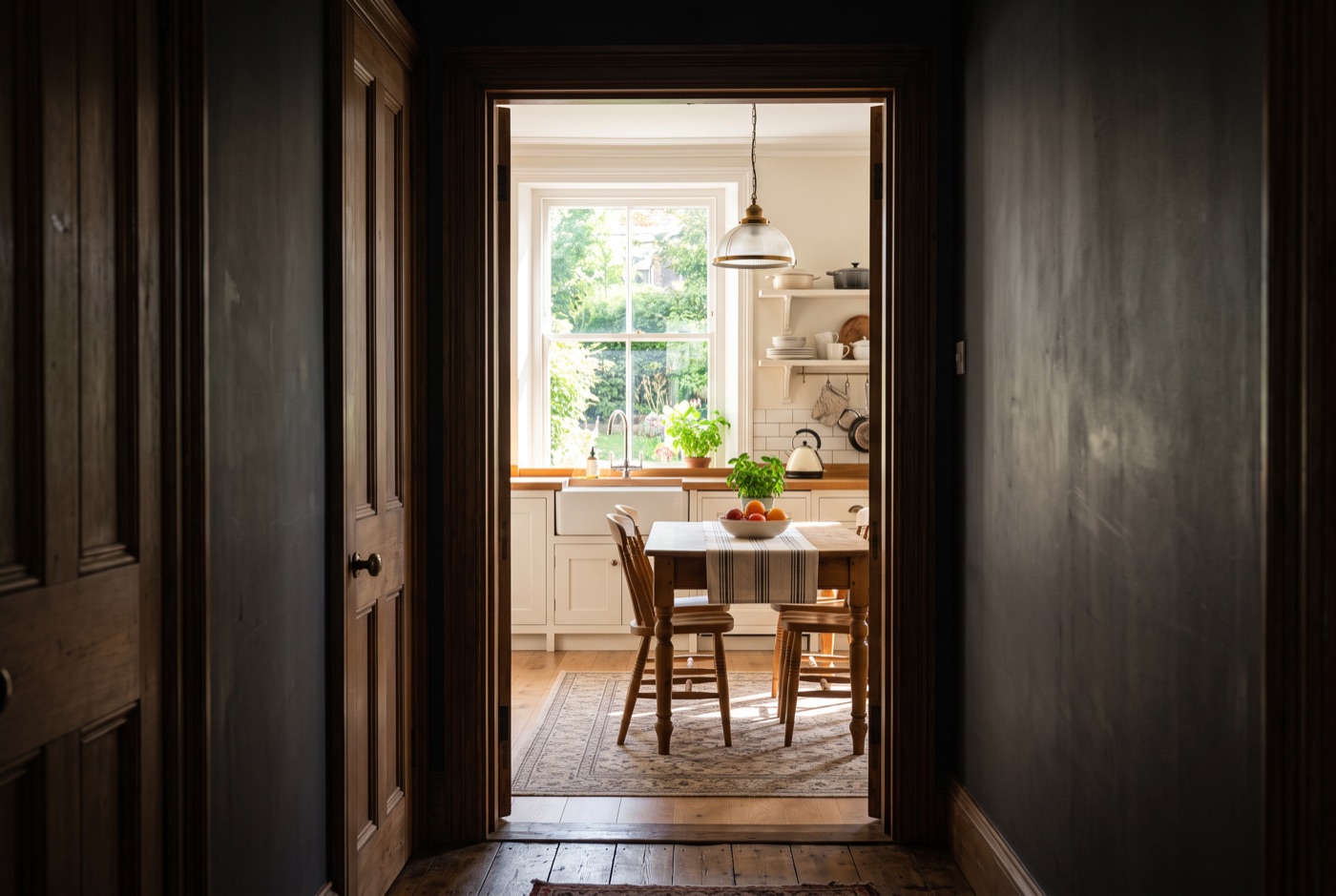
- Tease before reveal. A framing shot through a doorway previews the next space before you show it — discovery, built into the cut.
- Save one hero for last. First and last positions are the ones people remember (the serial-position effect) — so best shot first, second-best last, supporting shots in the middle.
- Hold the price to the end. An unanswered question keeps people watching; a “guess the price” overlay converts the price into that question and into a comment prompt. The trade-off is real: price up front qualifies leads, price at the end maximizes completion and comments. Pick per goal — reach reels end on the price, lead-gen reels can open with it.
What each camera move says
Moving a camera through a still photo isn’t decoration — each move has a meaning filmmakers have leaned on for decades:
- Push-in — focus and intimacy. “Look at this.” Use it on the money detail.
- Pull-back — context. The detail lives inside this larger space.
- Rise / drone-up — scale and grandeur. The move for the façade, the lot, the setting.
- Slow lateral drift — the calm survey; the camera equivalent of standing in the doorway and looking around.
- Orbit — three-dimensionality. “This is the centerpiece.”
- Reveal from a detail — suspense, then payoff. Start tight on the stained glass, open up to the porch.
One craft rule ties them together: speed is register. Slow, constant, controlled movement reads premium and contemplative; fast or jittery movement reads urgent and cheap. For a listing, err slow — especially above the median price point.
Transitions: mostly cuts, occasionally magic
- The hard cut is the default — invisible, rhythmic, and what the whole short-form genre is built on. Cut where the motion in two shots flows the same direction and the edit disappears.
- Cross-dissolves signal a soft shift of place or time — two or three per reel at most, or the whole thing goes soft.
- Doorway fly-throughs are spatial continuity made literal — the strongest possible “walk with me” cue, and worth saving for the one threshold that matters (front door, or into the great room).
- Cut on the beat — selectively. There’s real perceptual research showing on-beat and off-beat cuts are processed differently. But not every beat needs a cut: land the important shots (hero room, price reveal) on strong beats and let the rest breathe.
Rhythm and length
Attention is front-loaded: Nielsen’s analysis of Meta campaigns found a large share of a video’s total brand impact accrues from people who watch only the first seconds — so the opening shot plus hook must carry the message alone. Platform data consistently favors short, dense montages: roughly 2–3 seconds per shot, 10–20 seconds total, and a reel short enough to be rewatched beats a longer one watched once. If a viewer finishes and loops, the algorithm reads it as excellence.
The ending, mechanically
- One call to action. Choice kills action; “DM me for a tour” or “comment for the list” — never both.
- Respect the safe zones. Platform UI covers the bottom ~20% and the right rail; a price dropped at the bottom of the frame gets eaten by the caption box. Keep end-card text centered.
- Let it land. Give the final card a full 1.5–2 seconds. An ending that flashes by never becomes the “end” the peak-end rule needs.
Where Kadapt fits
Everything above is encoded in how Kadapt plans a reel: it recognises your rooms, sequences them in walking order, opens on the establishing shot, assigns each shot a named camera move (slow push, drone rise, golden-hour drift, doorway fly-through…) with premium pacing, lands captions on the right beats, and closes on price plus a single CTA. And every one of those choices stays editable, per shot, before you spend a credit — so the theory is the default, and your taste is the override.
Common questions
What order should photos go in a real estate reel?
Open on your most atmospheric exterior, then flow through the decision rooms — living space, kitchen, primary suite — in the order a showing would walk them, feature the one thing the comps don’t have, and close on a strong shot with the price and a single call to action.
Should the price go at the start or the end of a listing reel?
It depends on the goal. Price up front qualifies leads; price at the end keeps people watching and invites comments, especially with a guess-the-price overlay. Use the ending for reach reels and the opening for lead-gen reels.
How long should each shot be in a listing reel?
Roughly 2–3 seconds per shot and 10–20 seconds total. A reel short enough to be rewatched beats a longer one watched once — if a viewer finishes and loops, the algorithm reads it as excellence.
What camera moves work best for real estate video?
Each move carries a meaning: a push-in says look at this, a pull-back gives context, a rise conveys scale, a slow lateral drift surveys the room, and an orbit marks the centerpiece. Keep every move slow and steady — fast or jittery movement reads cheap, especially above the median price point.
Kadapt plans this sequence for you
Make my first reel →Free to the plan, no card · card only when you render · 14-day trial, 3 reels